Six weeks postpartum, you’re back on the mat doing crunches. And then you see it. A ridge pops up right down the middle of your belly, and the soft roundness won’t budge no matter how many reps you grind through. That ridge is called doming. It’s your body telling you the diastasis recti exercises you’re doing are making things worse, not better.
Here’s what nobody tells you: diastasis recti is a separation of the abdominal muscles along the midline, and the fix isn’t more ab work. It’s the right work, in the right order, with your breathing doing half the lifting, and ideally a personal trainer in Dubai who comes to you catching the doming before you have to.
Safe diastasis recti exercises focus on deep core activation and breathing, not crunches or planks. Start with transverse abdominis draw-ins, pelvic tilts, leg slides, glute bridges, and bird-dog, exhaling on each effort with no midline doming. Done 3 to 4 times a week, they rebuild core control without spiking pressure through the gap.
What Diastasis Recti Actually Is
Diastasis recti happens when the connective tissue down your midline, the linea alba, stretches and thins until the two halves of your rectus abdominis drift apart. It’s most common after pregnancy. But men get it too. So do non-pregnant women who’ve spent years doing high-load ab work.
The gap itself isn’t the problem. The pressure you push through it is.
Think about it this way. Traditional core moves force abdominal contents forward against that weakened line. As Harvard Health notes, exercises like sit-ups and heavy lifting spike intra-abdominal pressure, which bulges the midline outward instead of drawing it back together. So your standard ab routine? It’s often making the separation look worse. You’re essentially inflating a weakened balloon from the inside.
- The linea alba is tissue, not muscle. You can’t crunch it back together.
- Doming or coning down the midline during a move means stop. Right now.
- Back pain and a lower belly that won’t flatten are common companions.
- It can show up months or years after birth, not just in those first raw weeks.
Get that framing right and the rest of your training makes sense. You’re not chasing a burn. You’re teaching your core to manage pressure again.
Safe Diastasis Recti Exercises That Rebuild Your Core
The safest diastasis recti exercises all share one thing. They build deep core function without spiking pressure through the midline. Low and slow. Breathe out on the effort. Keep the belly flat the whole time. A GoodRx review of core-strengthening moves lands on the same foundational set that women’s health physios in Dubai use with their clients.
- Transverse abdominis draw-in: lie on your back, exhale, and gently pull your lower belly toward your spine. Hold 5 to 10 seconds, breathing normally, for 8 to 10 reps.
- Pelvic tilts: flatten your lower back into the floor on an exhale, ribs down, no bulging.
- Leg slides: from that braced position, slide one heel away and back without letting the belly pop.
- Glute bridges: lift the hips slowly with the deep core engaged, hold 3 seconds, then lower with control.
- Bird-dog: on hands and knees, extend one arm and the opposite leg while the midline stays flat.
Quality beats quantity here. Six clean reps with no doming will do more for you than twenty sloppy ones. And you progress only when the easier version stays flat and pressure-free. Not before. That part matters.

The Moves To Skip Until You’re Ready
Some of the most popular ab exercises are exactly the ones to shelve right now. Full sit-ups, long front planks, double-leg lifts, and heavy loaded work all drive pressure forward before your midline can handle it. This is exactly where working out with diastasis recti goes wrong for most people. A hard-charging return to the gym that sets them back further than if they’d done nothing at all.
Real talk: none of these are banned forever. They’re just sequenced. You earn them back once the gap narrows and you can hold pressure without doming under load.
Works well
- Low-load core work you can do most days without symptoms
- Walking and easy cycling to keep moving while the core rebuilds
- Wall push-ups and supported squats with a deliberate exhale
Worth knowing
- Crunches and V-sits often make the ridge more visible, not less
- Planks feel productive but can cone the midline under fatigue
- Running and jumping too soon can trigger leaking or pelvic heaviness
Skip a move if it domes. If you feel pressure at your pelvic floor. If anything leaks. Those aren’t signs to push through. They’re signs to go back a step. No shame in it. That’s actually the work.
A 15-Minute Routine You Can Do Anywhere
You don’t need a studio or a spare hour. A short, focused routine done 3 to 4 times a week beats a marathon session you dread and end up skipping. This one fits into a morning before the 7am scramble, a hotel room in Abu Dhabi on a work trip, or the gym in your building at 10pm when the kids are finally down. BodySpec frames the same low-load progression, and their safe-recovery breakdown is a solid second read.
| Exercise | What it trains | Reps |
|---|---|---|
| Transverse draw-in | Deep core | 8-10, hold 5s |
| Pelvic tilts | Core control | 10 slow |
| Leg slides | Core plus control | 6-10 each side |
| Glute bridges | Glutes and core | 10, hold 3s |
| Bird-dog | Core stability | 6-8 each side |
- Breathe out on every effort, in on every release.
- Keep one hand on your lower belly to feel for doming.
- Stop a set the moment your form breaks, not when you hit a number.
Run through it slowly and the whole thing takes 12 to 15 minutes. Four short sessions a week will outperform one heroic hour every single time. The consistency is the whole game here, not the intensity.

Who This Is For, And Who It’s Not
This approach fits you if you’re a few weeks to a few years postpartum, cleared to exercise, and tired of routines that make your belly pop. It fits men carrying a stubborn midline gap too. Our male personal trainers in Dubai see this more often than people expect. And anyone rebuilding a core after abdominal surgery, once they have medical clearance.
But it’s not for everyone, and we’ll say so plainly.
- This is for you if you can commit to slow, boring reps for a few weeks before the harder work starts. Those boring reps are building the foundation everything else runs on.
- This is for you if privacy matters and you’d rather not do pelvic-floor work in a packed tower gym.
- Skip the DIY route if you have pain, heaviness, or leaking. That’s a physio referral, not a home program. Full stop.
- Skip it if you want a quick fix. A separation that took nine months to form doesn’t close in one.
Honest trade-off: if you’re chasing a hard six-week deadline for a wedding or a shoot, this steady approach will frustrate you. It works. But it works on tissue’s timeline, not yours.
How We Run This In Your Dubai Building
In Dubai, most of this can happen right in your own building. A mobile trainer comes to your apartment in Business Bay, your villa in the Hills, or the gym floor of your Marina tower. No commute. No audience. That privacy matters more than people admit when the work involves your pelvic floor. If you’ve been putting this off because gym floors aren’t exactly private, that’s the specific problem we solve.
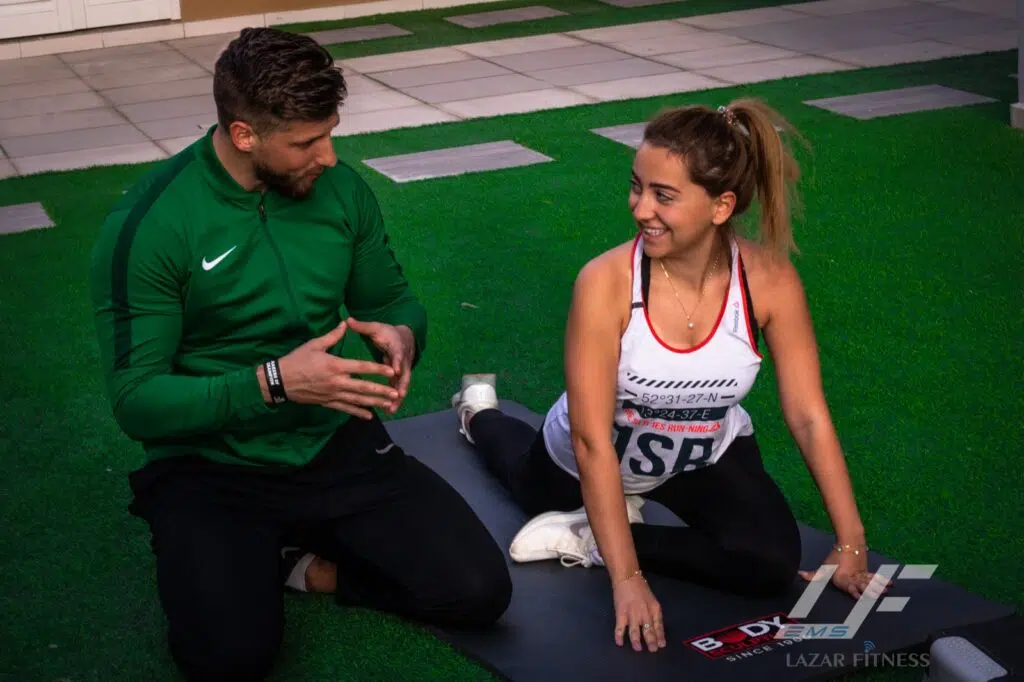
The bigger value is the trained eye. The most common mistake with diastasis recti exercises isn’t choosing the wrong move. It’s not spotting your own doming. You can’t see the middle of your own belly while you’re flat on your back. A coach catches it in the first rep. Our pre and post-natal personal trainer in Dubai, Maria, runs diastasis-safe sessions that fold into real strength work as you progress. Not endless rehab drills. Actual training that gets harder over time.
- Early mornings before work, late evenings after the 7pm SZR crawl, or gaps between meetings.
- Sessions that travel with you to the hotel gym on business trips.
- Progression from bracing to loaded lifts, paced to your body, not a calendar. Ready to start? Book a trial session and we’ll map your baseline in the first ten minutes.
The bottom line: Safe diastasis recti exercises are about deep core control, breathing, and patience. Not harder ab work. Start with the low-load basics, avoid the pressure spikes until you’ve earned them, and get a trained eye on your doming early. Fifteen focused minutes at home beats an hour you’ll skip.