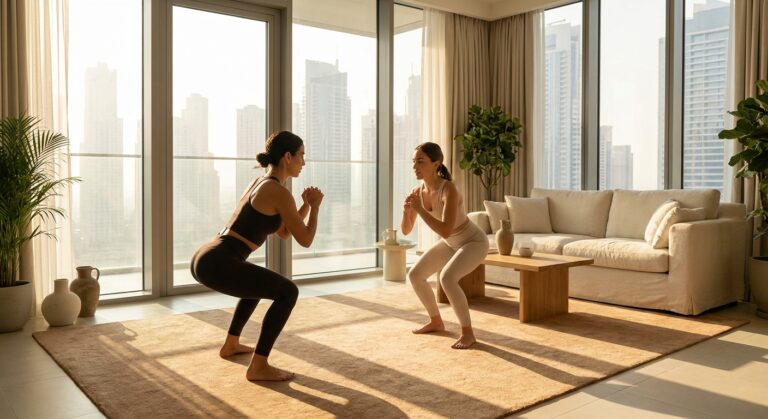
You’re 14 weeks in. It’s 45 degrees outside and your WhatsApp is full of opinions. One friend swears by prenatal yoga, another just booked prenatal pilates in Dubai, and your OB basically said keep moving. So here’s the real question: prenatal yoga vs pilates vs personal training, which one actually fits a growing bump and a calendar that doesn’t slow down? Here’s how a personal trainer in Dubai thinks through it.
Choosing between prenatal yoga vs pilates vs personal training comes down to your goal. Yoga suits stress relief, breathing, and flexibility. Pilates builds posture, pelvic stability, and core control. Personal training is the most customized and schedule-friendly, adapting around travel and fatigue. In uncomplicated pregnancies, all three work with medical clearance and pregnancy-specific modifications.
What safe pregnancy training actually looks like in Dubai
Before you pick a format, get the ground rules straight. They apply to all three options, and they matter more than the format debate.
The NHS exercise-in-pregnancy guidance says stay active most days and keep intensity where you can still hold a conversation. In Dubai, that one point does all the heavy lifting. Train indoors with the AC on. Full stop. This isn’t about doing less. It’s about doing the right things in the right environment, with water within reach and your core temperature in check.
- Aim for around 150 minutes of moderate activity a week. Spread it across the week, don’t try to cram it into one long Saturday session and call it done.
- Get your doctor’s clearance first, especially if you’re dealing with bleeding, high blood pressure, or a high-risk pregnancy.
- Avoid overheating and dehydration. Skip outdoor workouts from May through October. In Dubai’s summer heat, this isn’t optional, it’s just sense.
- After roughly 16 weeks, avoid long stretches lying flat on your back. This affects both yoga and pilates, so a good instructor or coach will already know to modify around it.
- Never hold your breath through effort, and stop immediately if you feel pain, dizziness, or shortness of breath. Those are signals, not suggestions.
Whether you end up in a class or working with a coach, these rules stand. Most reputable pregnancy fitness options in Dubai already build around them. If they don’t, that’s your sign to find somewhere else.
Prenatal yoga: what it’s actually good for
Prenatal yoga is the easiest option to start and the best one for winding down. If your main pregnancy complaints are stress, broken sleep, a stiff lower back, or the kind of anxiety that hits at 2am, prenatal yoga earns its place.
- Breathwork that genuinely helps with sleep and with staying calm as labour gets closer. Not a small thing when your brain won’t switch off.
- Gentle mobility for hips, spine, and shoulders that get tight from sitting in front of a screen all day. Desk work and pregnancy are not a great combination.
- A slower pace that feels manageable in the first-trimester fog of nausea and fatigue, when everything feels like a lot and you haven’t told most people yet.
- Low equipment needs, so it actually works when work takes you to Riyadh for a week and all you have is your hotel room floor and a travel mat.
Tommy’s, a UK pregnancy charity, keeps clear yoga safety notes for pregnancy: move slowly, avoid deep twists and back-lying poses later on, and never push into a stretch. In practice, a good prenatal class also leaves you calmer for the rest of a long, stressful work day. That’s not nothing when your sleep is already broken and you’ve got a 9am presenting to leadership tomorrow.
Here’s the catch though. Yoga keeps you calm and supple, but it won’t systematically build strength or give you anything measurable to track. Prenatal yoga works if you want self-care and gentle movement on a stable schedule. But if your goal is holding onto real strength or fixing actual pain, skip it as your only training. It’s not designed for that.
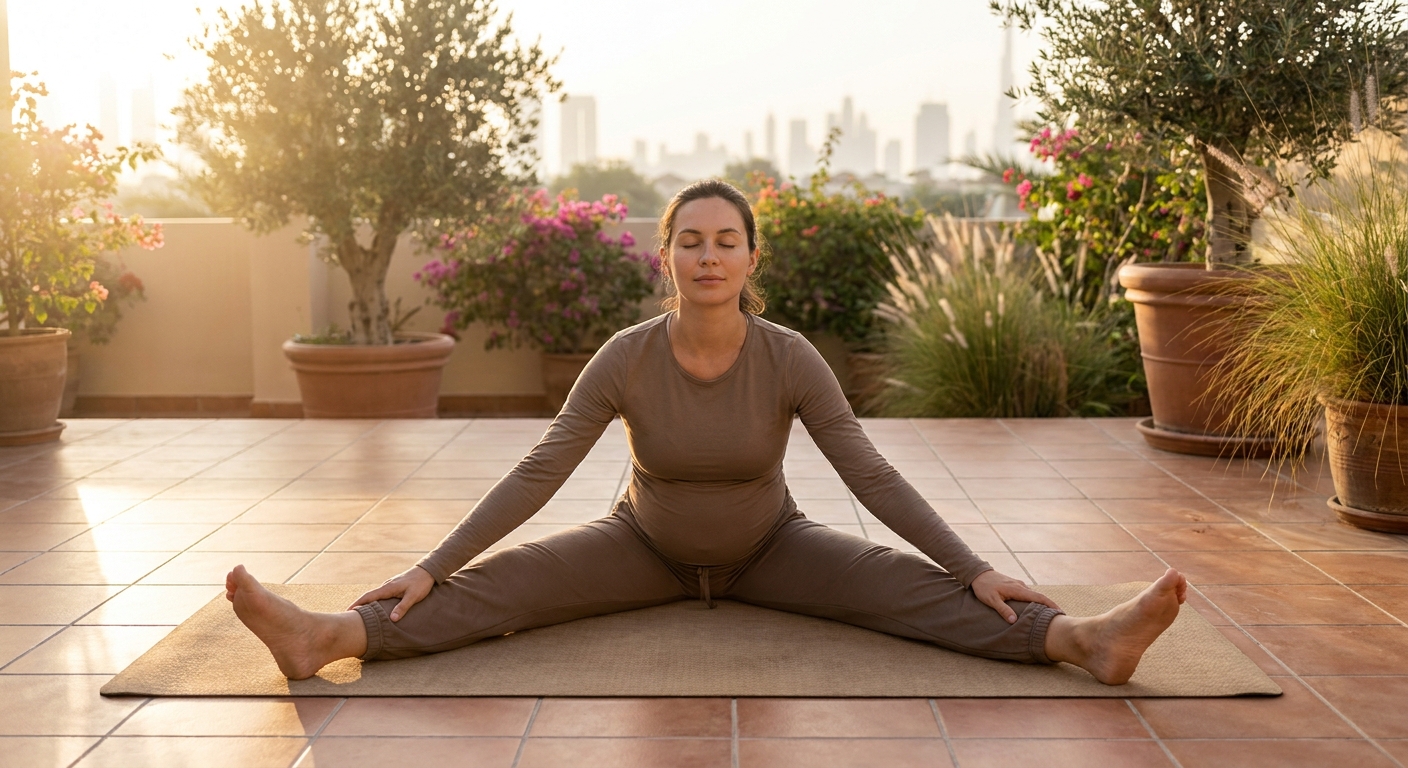
Prenatal pilates: posture, core control, and pelvic stability
If yoga is about calm, prenatal pilates is about control. It’s the strongest class format for posture, deep core support, and pelvic stability, and those are exactly the things that suffer after long hours in meetings, a commute through DIFC traffic, and months of a shifting centre of gravity.
- Trains the deep core and pelvic floor without the crunch-style work you should be avoiding now anyway.
- Improves posture and glute control, which directly eases the lower-back ache that creeps in through the second trimester and doesn’t really take a hint.
- Low impact and precise, so it modifies well as your bump grows and the things you can comfortably do shift from month to month.
- Builds body awareness that genuinely pays off during delivery and in the recovery weeks after. Ask anyone who did it consistently.
For anyone glued to a laptop all day, that postural work is often the difference between an achy third trimester and a manageable one. The hours at the desk compound. Pilates is one of the few formats that actually addresses that directly during pregnancy.
Real talk though: prenatal pilates in Dubai is only as safe as the instructor’s training. A good one avoids deep abdominal loading, watches for doming or coning of the belly (that’s a sign the load is too much), and drops the long back-lying work after about 16 weeks. If your instructor isn’t actively checking for those things, find a different class.
Prenatal pilates works if you want structured posture and core work and you can protect a regular class slot week to week. But if your schedule is unpredictable, you travel constantly, or your diary looks different every single week, a fixed class time is genuinely hard to stick to. That’s not a willpower problem. It’s a logistics problem, and it’s exactly where the prenatal yoga vs pilates vs personal training question gets practical.
Prenatal personal training: the flexible, results-focused option
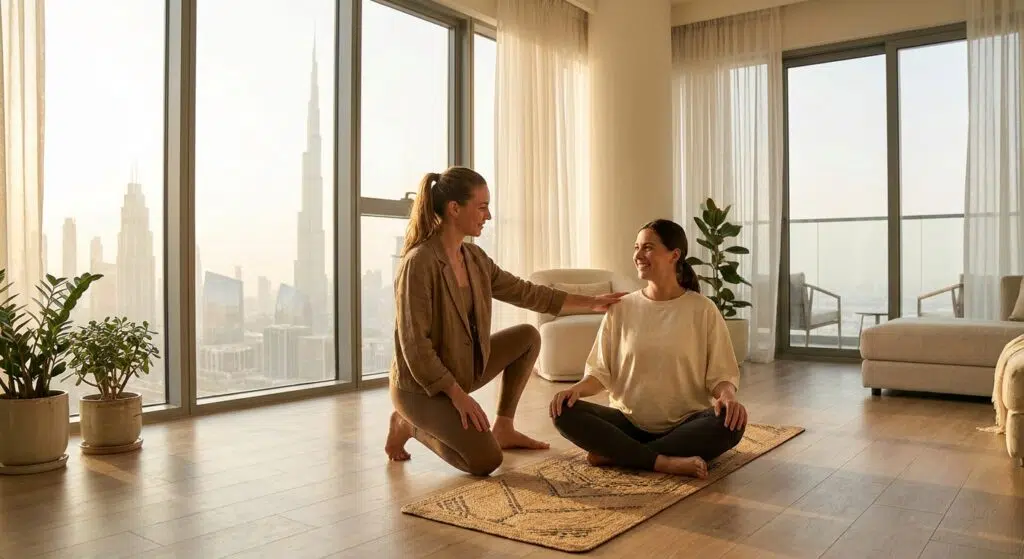
Prenatal personal training is the most individual of the three, and for someone with a packed, shifting calendar, it’s usually the most realistic. There’s no fixed class to rearrange your week around. A coach builds the session around your trimester, your symptoms, and your actual week, not around a timetable on the studio wall.
Because this is a mobile service, sessions happen where you already are. Your building’s gym in Business Bay, a villa gym in the Hills, a hotel gym when you’re travelling for work. That removes the commute and the 7pm crawl on SZR, which is often the real reason consistency slips, not motivation. The drive kills the session before it starts.
A qualified coach keeps strength and mobility progressing with the modifications the ACE guidance on training through pregnancy sets out: moderate intensity, the talk test, steady adjustments as you progress. This isn’t box-ticking. It’s what separates a programme that works the whole way through from one that stalls at 24 weeks because no one actually adapted it.
- Programming that adjusts session by session around fatigue, nausea, and swelling. Because those things change week to week, not neatly by trimester.
- Pelvic floor and posture work folded into strength and mobility every session as standard, not bolted on at the end when time runs short.
- One coach who knows your full picture, so nothing gets missed or guessed at as things shift throughout your pregnancy.
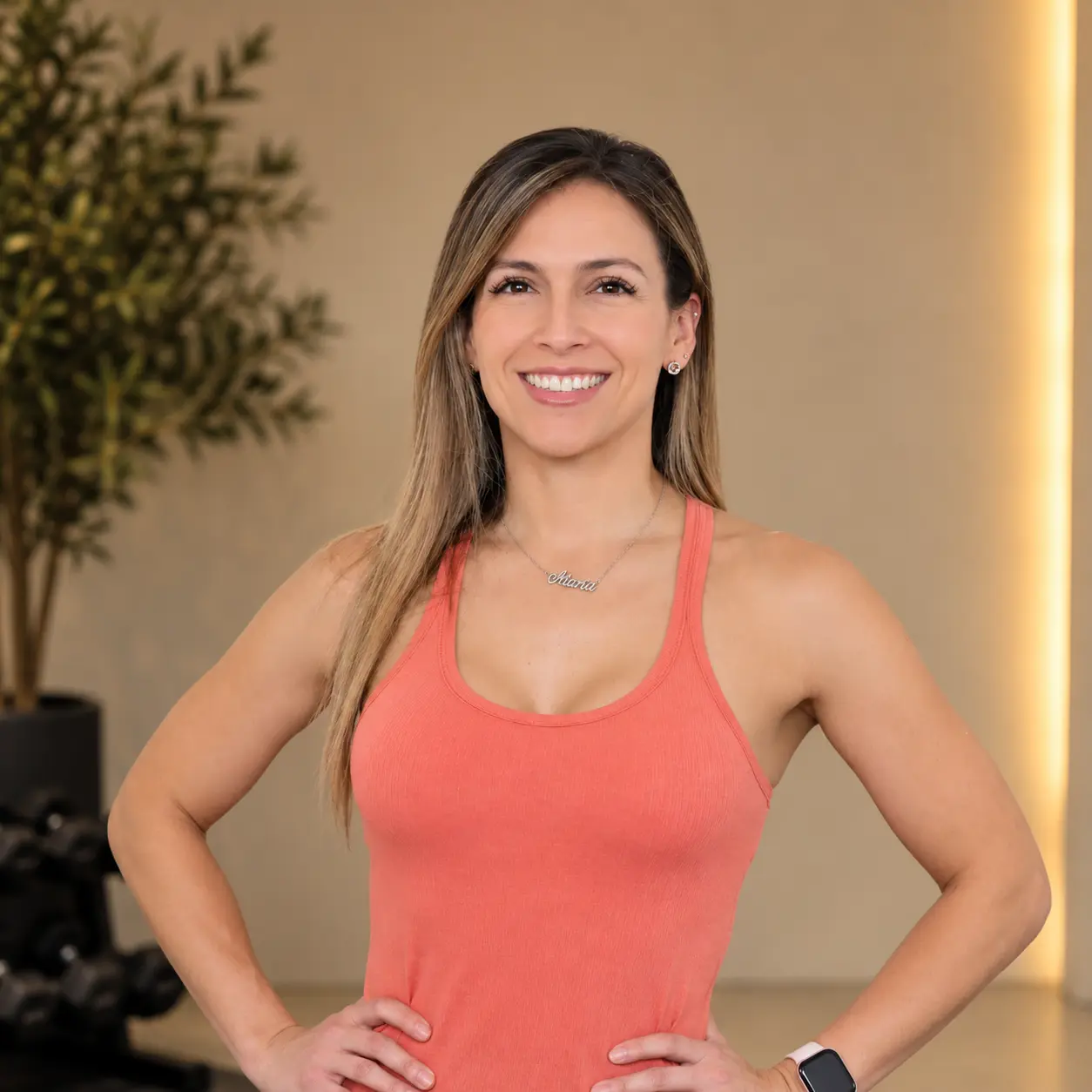
And when a big deadline lands and your week implodes? The session moves with you. It doesn’t disappear. Our prenatal personal trainer in Dubai works clearance-first, and many clients start specifically with a female personal trainer in Dubai for comfort. Our coaches are IFBB and REPs certified with 8+ years working in Dubai and a 5.0 Google rating.
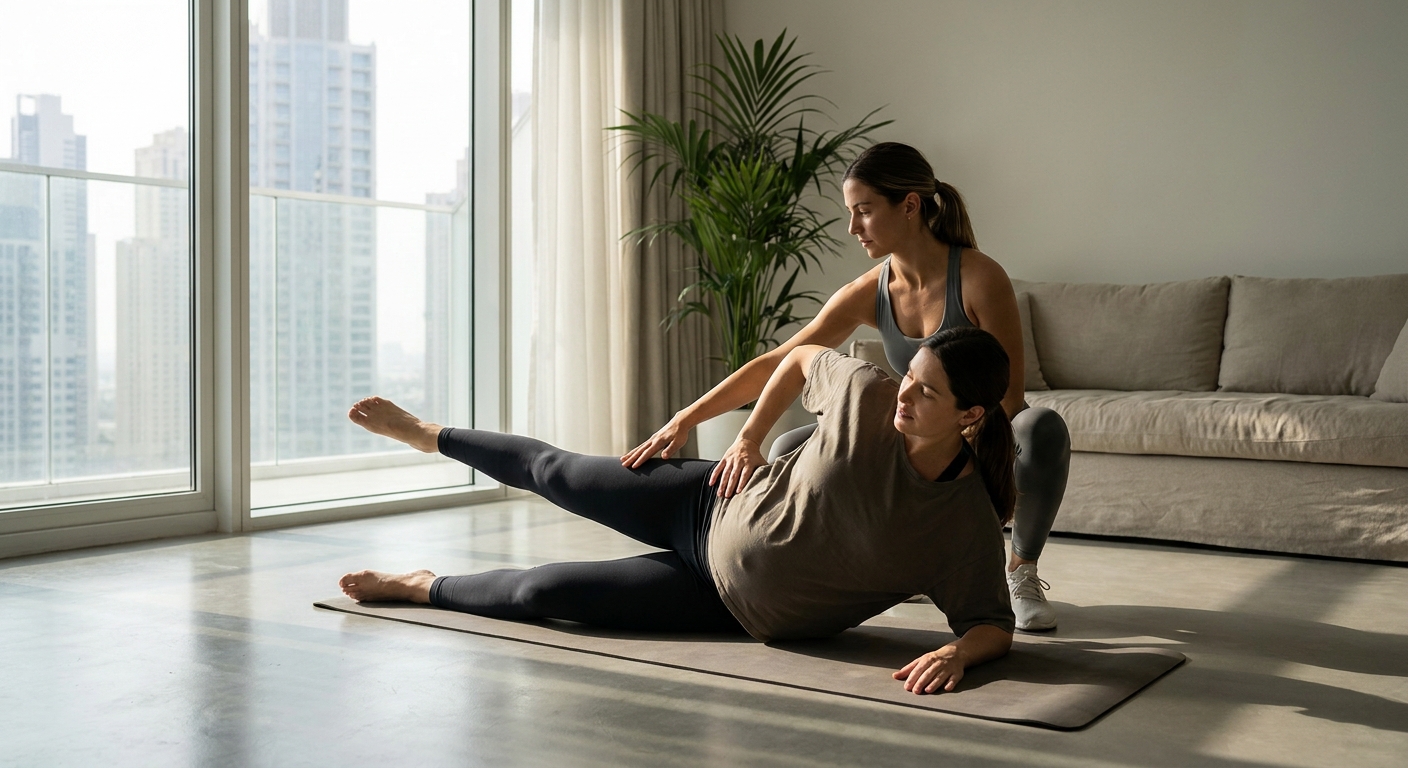
Prenatal yoga vs pilates vs personal training, side by side
Yoga is best for calm and mobility. Pilates is best for control and posture. Personal training is best for results and adaptability. When it comes to prenatal yoga vs pilates vs personal training, that’s the short version. Here’s the same idea as a quick reference. Think about your priority this month, not which format sounds most appealing in theory, and the choice gets a lot simpler.
| Your priority | Best pick | Why it fits |
|---|---|---|
| Stress, sleep, stiffness | Prenatal yoga | Breathwork and gentle mobility at a calm, low-intensity pace |
| Posture, core, pelvic stability | Prenatal pilates | Controlled, low-impact core work with real precision |
| Consistency despite travel and long days | Personal training | Comes to you and adapts around your week and symptoms |
Most women don’t pick just one, and that’s completely fine. A common setup is pilates or yoga for movement you actually enjoy, plus a female personal trainer in Dubai to keep strength and posture on track. Use what each format does best rather than picking a side.
Works well
- Adapts session by session around travel, fatigue, and swelling without losing continuity.
- Sessions happen at your own building, so there’s no commute and no missed session because you got stuck at work until 8.
- One coach progresses the load safely as your trimester changes and your body does too, nothing gets guessed at.
- Pelvic floor and posture built into every session as standard, not an add-on that gets skipped when the hour runs short.
Worth knowing
- It costs more than a group class, and that’s a real thing to weigh properly before you commit.
- You lose the shared energy that some women genuinely love in a group class setting. That’s not nothing.
- It’s only as good as the coach’s actual prenatal experience. Not all certifications are equal. Ask specifically about pregnancy training before you book.
- You still need your doctor’s clearance, same as any format.
Who each option is actually for
The prenatal yoga vs pilates vs personal training choice comes down to your goal and your schedule, not which format is trending this year. Here’s the plain version.
- Choose yoga if your week is stable and you mainly want to de-stress, sleep better, and stay mobile. It genuinely does those things well.
- Choose pilates if you want structured posture and core work and you can actually protect a regular class slot week to week without it disappearing into meetings.
- Choose personal training if your calendar is unpredictable, you travel regularly for work, or you want measurable progress with modifications that shift as you do.
- Choose a mix if you have the time and budget, using classes for movement you enjoy and a coach for structure and real progression.
And if you have a high-risk pregnancy or your doctor has limited your activity, none of these start until you get the green light. Then only under proper guidance. That part isn’t negotiable.
The bottom line: For someone in Dubai with a shifting, demanding schedule, prenatal personal training is usually the most reliable option. It fits around travel, fatigue, and a calendar that never stays the same, while still tracking real progress. If your week is stable and you mainly want calm or gentle core work, yoga or pilates can be genuinely all you need. Whatever you pick: keep it indoors, get cleared by your doctor first, and work with someone who actually knows pregnancy.The format matters less than getting those three things right. If you want to explore prenatal personal training, book a trial session.