
The shelf at 9pm is stacked with protein water, protein crisps and protein bread, and not one of them answers the question you actually walked in with. So, how much protein do I need? Take your weight in kilos, multiply by 1.6, and you’re done, because at 80 kg that’s 128 g a day, and that single number covers almost everyone lifting two or three times a week. It is not a round number somebody invented: a 49-study meta-analysis in the British Journal of Sports Medicine found gains from extra protein flattened out at about 1.6 g per kilo.
Here’s what the label won’t tell you. Most people reading this are already close, sitting near 90 or 100 g without trying, which means the gap is one meal wide rather than a full lifestyle rebuild. We see this with almost every new client who starts working with a personal trainer in Dubai: closing it costs less than a single week of delivered meals, and it usually takes about ten days before you stop thinking about it at all.
How much protein do I need comes down to your weight and your training. 0.8 g per kilo, the WHO and FAO requirement, only prevents deficiency. If you lift or run, 1.2 to 1.6 g per kilo is the useful band, so 96 to 128 g a day at 80 kg. Above 2.0 adds cost, not muscle.
How much protein do I need each day
Two multipliers, and you can do both standing in the aisle. Weight in kilos times 1.6, or weight in pounds times 0.73, and the old baseline, the one that just keeps you out of deficiency, is 0.8 per kilo or 0.36 per pound. That’s the floor of the room, not the ceiling you’re aiming at.
Here’s how it plays out for a real person, because the maths only means something once you attach it to a life. A 42 year old at 84 kg who trains three evenings a week: 84 times 1.5 gives 126 g a day, and spread across four eating times that’s about 30 g each, roughly one palm of meat or fish on every plate. Not complicated, just four decent sized portions instead of one huge dinner plate.
- 0.8 per kilo. Stops you going short. Nowhere near enough if you actually train.
- 1.0 to 1.2. Past 40, not lifting, trying to hold onto what you’ve got.
- 1.1 to 1.5. Training most weeks, a mix of cardio and weights.
- 1.2 to 1.7. Lifting seriously with a strength and conditioning coach, or building toward a distance event.
- Above 2.0. Surplus territory. Your body burns it or stores it, and it never banks it for later.
Carrying a lot of extra body fat changes the sum, because fat tissue doesn’t need feeding the way muscle does. So when we work out how much protein someone needs, we use an adjusted weight instead of the number on the scale, especially when we programme nutrition for a new client starting our 12 week transformation.
- Start with ideal weight. A 110 kg man at 178 cm has an ideal weight near 73 kg.
- Add 40 percent of the gap. The difference is 37 kg, so 40 percent of that is roughly 15 kg, added to 73 kg gives 88 kg.
- Multiply by his band. 88 times 1.4 is 123 g, not the 154 g you’d get from his real weight on the scale.
Why 0.8, 1.6 and 2.0 all turn up in the same search
Open three tabs and you’ll get three different answers, and that’s not because the science is a mess. It’s because each number answers a different question, and none of those pages tells you which one it’s actually answering.
| The number | Where it comes from | Who it fits | What we do with it |
|---|---|---|---|
| 0.8 per kilo | The old daily allowance | A sedentary adult | A check that you aren’t short, never a goal |
| 1.0 to 1.2 | Guidance for adults past 40 | Not training, holding muscle | Our starting point when someone has stopped lifting |
| 1.2 to 1.6 | Muscle building reviews | Anyone training with weights | Where most people we coach sit |
| 1.4 to 2.0 | Sports nutrition position stand | Hard training, or eating in a deficit | Top end only when both are true |
| Above 2.0 | Marketing | Nobody we coach | Skip it |
Two things worth saying plainly. The higher guidance now doing the rounds online didn’t arrive with dramatic new evidence behind it, and the bands Mayo Clinic Health System gives for people who exercise have barely moved in years. The International Society of Sports Nutrition puts 1.4 to 2.0 per kilo as sufficient for almost anyone training hard, and the joint position of the Academy of Nutrition and Dietetics, Dietitians of Canada and the American College of Sports Medicine lands in the same band. That’s the ceiling, not where you start.
Then there’s the ranking nobody selling powder wants printed: lifting does far more for your muscle than protein ever will. Protein is what lets the training pay off, and without training it’s just expensive food sitting in your stomach. So if the kilos still confuse you, cross-check against calories instead. Protein wants to land between 10 and 35 percent of your intake, and 25 to 30 percent is where most of the people we coach end up.

What the number costs, and what it actually buys
Nobody puts a price on how much protein you need, which is strange, because cost is the first objection anyone raises when we bring it up. Here are rough shelf prices in Dubai, per 30 g of protein. Treat these as a sanity check rather than a quote, because they move around week to week.
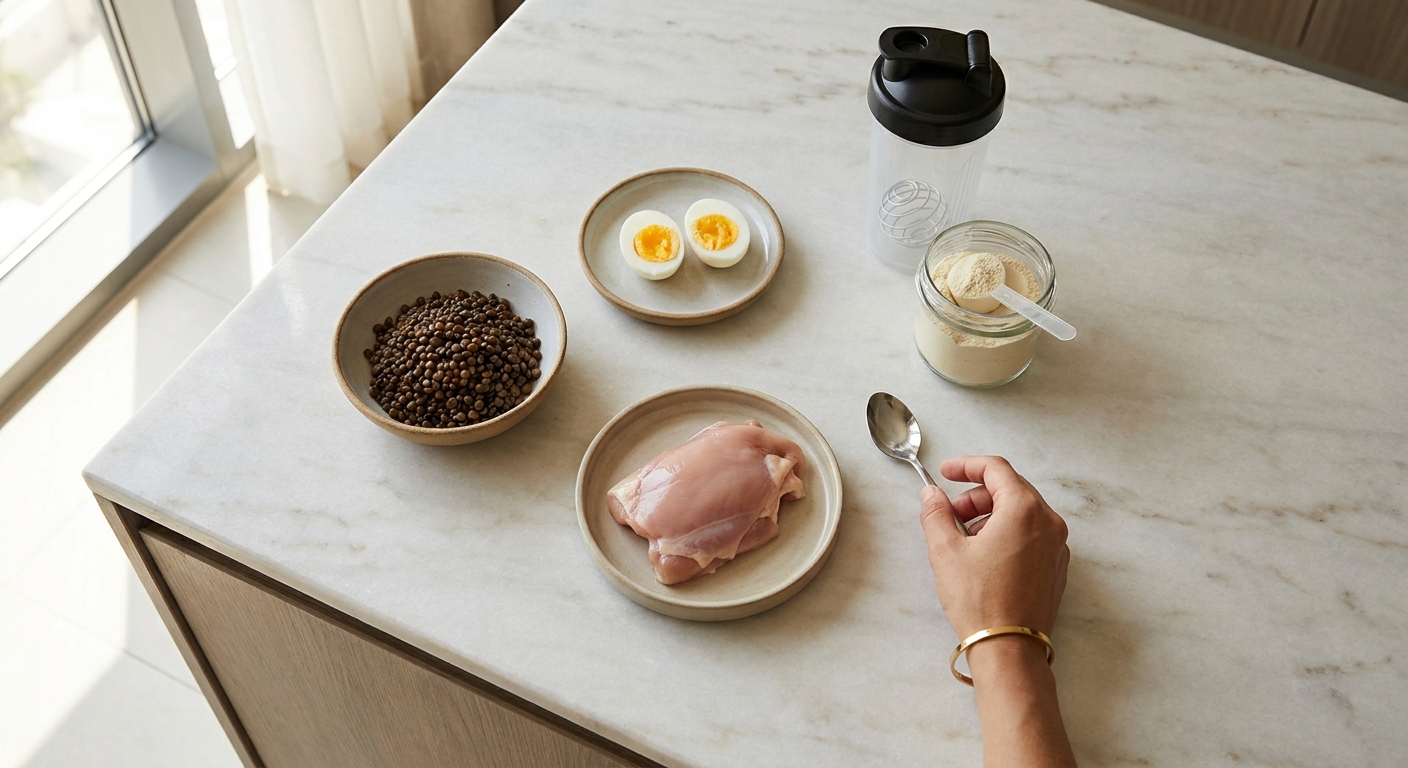
- Lentils, about AED 2. The cheapest protein you can buy here, by a distance.
- Eggs, about AED 3. Five eggs, and you get the fat and micronutrients thrown in for free.
- Chicken thigh or breast, about AED 4. Roughly 135 g raw.
- Whey, about AED 5. Convenient, and nothing fancier than that.
- Canned tuna, about AED 5. The one that survives a hotel room with no kitchen.
- Greek yoghurt, about AED 10. The priciest per gram, and still worth keeping in the fridge.
Build a week at 140 g a day out of those, and the protein part of your shop lands somewhere near AED 120 to 180. A delivered meal plan runs several times that, and you’re paying for the cooking and the driver there, not the protein itself. Both approaches work. Only one of them survives a month you didn’t plan for, like the one where work got busy and you stopped meal prepping on Sundays.
Where a shake earns its place
- You’re travelling and breakfast is a buffet of bread
- Your appetite is small and 30 g of solid food at 7am is genuinely hard
- You train at 6am and don’t eat properly until 9am
Worth knowing
- Protein arrives packaged with other things, and the package matters. A powder gives you the gram and none of the fibre, iron or fat
- Two shakes a day usually means a meal is broken somewhere, and fixing that meal fixes more
- High protein eating built on mince, cheese and processed meat rides on a lot of saturated fat
Almost nobody has a protein problem at dinner. They have a breakfast that contains none.Lazar, Train With Us
Eating out in Dubai without losing the number
Every article on this topic assumes you cook. At 8pm on a Thursday, you’re not cooking, you’re ordering, so here are working estimates for what you’re actually eating. Useful for planning rather than lab accurate.
- Chicken shawarma: around 20 g. Two of them is a meal, one is a snack.
- Mixed grill: 60 to 80 g. The most protein dense thing on any menu in this city.
- Chicken biryani: around 30 g, most of the plate being rice.
- Mezze spread: 15 to 20 g unless someone orders grilled meat alongside it.
- Hotel brunch plate: 40 g plus, if you build it right at the carvery and the egg station.
- Café salad bowl: around 20 g, which is exactly why you’re hungry again by 4pm.
Three ordering habits lift a normal restaurant meal by 20 to 30 g without any drama, and we ask every client to try at least one of them for a fortnight before judging it. Order a grilled protein as a side dish alongside your main. Swap one carb side for a second protein instead. Or ask for double meat in the wrap or the bowl. Almost every kitchen here will do it without blinking.
If someone else cooks at home and the meal is built on rice and bread, don’t try to rewrite the whole family menu. Why would you, when the fix is smaller than that? Just add one anchor to the plate that’s already there: a bowl of curd, a doubled portion of dal, two eggs, a grilled piece on the side. That’s a change you can actually hold for years, not just for the two weeks you’re motivated.
Instead of
- Café salad bowl, 20 g
- Two flatbreads with the mezze
- Cereal and coffee at 7am
Try
- Same bowl, double chicken, 40 g
- One flatbread and a grilled skewer, plus 25 g
- Three eggs and yoghurt, 35 g
A full day that gets there, meat or no meat
Here’s what 135 g looks like once it’s just food on a plate: no powder, no kitchen scale, four eating times spread through the day.
A day of eating at around 1,800 calories
Example only. Your numbers depend on your size, your job and how you train.
Protein
135 g
Carbs
180 g
Fat
60 g
- 07:3035protein
Breakfast
Three eggs and a small tub of Greek yoghurt with berries mixed in.
- 13:0045protein
Lunch
Grilled chicken, rice and a big salad, ordered in with double meat.
- 17:0020protein
Before training
Cottage cheese, or milk with a scoop stirred in if the day ran away from you.
- 20:3035protein
Dinner
Salmon or beef, potatoes, vegetables cooked with olive oil.
Four meals, nothing between them
Aim for 20 to 40 g every time you eat, because past roughly 40 g in one sitting you stop getting any extra benefit from it, so a 90 g dinner isn’t going to rescue an empty morning.
You don’t need a food scale to run any of this. A palm of meat, fish or paneer is roughly 25 to 30 g, so count only your anchors for three days and ignore everything else on the plate. If you can’t name three anchors on a given day, that’s your answer right there.
Vegetarian works fine, and the incomplete protein idea is dead. You don’t need to combine anything at a single meal, you just eat a variety across the day. What is true is that plant sources are less efficient at flipping the muscle switch, mostly down to a single amino acid called leucine, so we tell vegetarian clients to add 20 to 30 percent on top of their number.
| Plant food | Portion | Protein |
|---|---|---|
| Dal | 1 cup | 9 g |
| Paneer | 100 g | 18 g |
| Curd | 1 bowl | 7 g |
| Chana | 1 cup | 15 g |
| Tofu | 150 g | 17 g |
| Dry soya chunks | 50 g | 25 g |
Stack four of those and you’re at 60 g before dinner even starts.
Ramadan, 45 degree summers and the weeks you miss
Every other page tells you to spread protein evenly across the day. During Ramadan that advice is useless, because you only have two eating windows, so you get two anchors instead: 50 to 60 g at iftar and 40 to 50 g at suhoor gets a normal adult to target without anything clever. Break the fast with dates and water first, then eat the protein while you still have an appetite for it.
Training that month moves to just before iftar, or ninety minutes after it, and volume comes down. You’re holding onto muscle, not building it, and that takes far less work than most people assume, so we tell clients to stop overthinking the meal timing windows. It matters less than the food itself.
Summer is the other local variable nobody writes about. Protein doesn’t dehydrate you, that’s a myth that won’t die, but clearing the by-products of a higher intake does use fluid, and July here pulls a lot of it through your skin before you’ve even noticed you’re sweating. So if you’re eating above 1.6 per kilo and training outdoors, your water intake needs to go up with it. That’s the whole rule.
And the days you miss? This is a weekly average, not a daily exam you can fail. A 90 g Friday undoes nothing on its own, and five solid days out of seven beats a perfect fortnight followed by quitting altogether.
Where more protein won’t help you at all
If you’re not training, adding more protein changes very little. We’ve raised intake for people and watched the scale and the mirror stay exactly where they were, right up until the lifting changed, because the food supports the work, it doesn’t replace it. That’s why we’d rather sort out your two sessions a week first, whether that’s in a tower gym you already pay for or with a coach who trains you at home.
Protein intake for weight loss is the one place the higher end genuinely earns its keep. Eating in a deficit, or on a GLP-1 medication where appetite falls off a cliff, protein is the thing to protect while everything else shrinks around it. On the kidney question, Mayo Clinic Health System is narrow and honest about it. The caution applies to people already at risk, not to everyone reading this, so if that’s you, ask your doctor before going near the top of the band.
To the women who quietly avoid it because they think it makes you bulky: it doesn’t. It’s a question that comes up constantly with clients working with a female personal trainer in Dubai, and under-eating protein while dieting is how you lose the shape you were training for in the first place. We’ve watched this happen to smart, disciplined clients who simply believed the wrong headline.
Nobody jumps from 70 g to 130 g in a week and stays there, so we ramp it instead. Week one, fix breakfast only. Week two, add an anchor at lunch. Week three, the afternoon. Week four, dinner. What actually happens? People usually report feeling full and slightly annoyed by it early on, less evening snacking by week two or three, and by the fourth week it stops feeling like effort at all. Appetite settles within days, recovery within a few weeks, body composition over months, and only alongside training.
The bottom line: So, how much protein do you need? Multiply your weight in kilos by 1.4 if you train a few times a week, by 1.6 if you’re lifting properly, and stop there. You’re probably closer than you think already, and the gap is almost always breakfast. Make one swap at your next meal, eggs and yoghurt instead of coffee and bread, and leave the rest of the day alone.