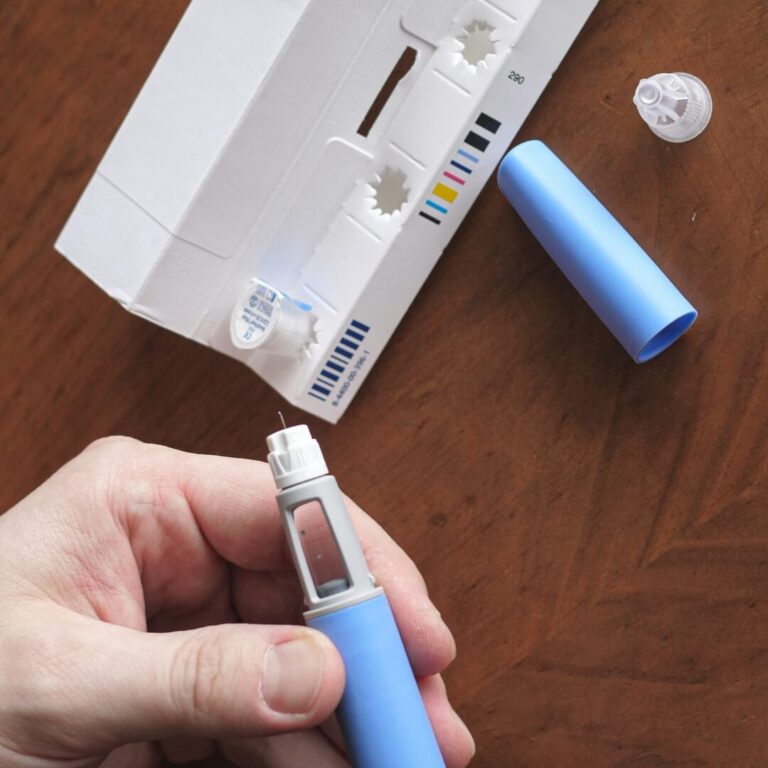

You can’t burn belly fat by training the belly. Belly fat exercises build the muscle under the fat, but the fat comes off everywhere at once, through a calorie deficit, three lifting sessions a week and a daily step target. Core work shapes what shows once the fat drops. Give it 8 to 12 weeks.
Why belly fat exercises don’t burn belly fat
You’ve done the crunches at 6am for months, the belly fat exercises every fitness app lists, and the tape at your navel hasn’t moved a centimetre. Your abs are stronger. Your back feels fine. That’s the story I hear in almost every first session as a personal trainer in Dubai, and it’s not a willpower problem. It’s a targeting problem, and once you see it, the whole plan changes.
Ab work trains the muscle sitting under the fat. It doesn’t touch the fat itself, no matter how many belly fat exercises you do. Eat less than you burn and your body pulls energy from fat stores all over you, in an order your genes and hormones decide, not whichever muscle is sore that day.
- One small randomised trial found a small local effect from long abdominal endurance work.
- A 6 week trial of normal ab training found no measurable change in waist size or belly fat thickness.
Don’t bank on the exception. Plan around the rule instead.
Two kinds of fat live here. The soft fat you can pinch sits under your skin, right where your fingers land. Visceral fat sits deeper, wrapped around your organs, and it’s the one tied to heart disease and type 2 diabetes. You can weigh a normal amount on the scale and still carry plenty of it. A waist over 94 cm for men or 80 cm for women is where the risk starts climbing, regardless of what the mirror tells you.
Ab work still earns its place: better posture, a back that copes with long flights and longer desk days, definition once the layer on top thins out. Keep it in your plan, two or three moves at the end of a lift is plenty. Just stop asking it to do a job it was never built for.
What actually moves the tape
Three things shrink your waist, and you need all three: eating a little less than you burn, lifting, and moving daily. Cardio helps, but if you’re stuck at a desk from 9 to 6, walking does most of the heavy lifting anyway. If your week has no room for three lifts, EMS training in Dubai compresses the same stimulus into two 20 minute sessions, though it’s the exception here, not the starting point. It isn’t for everyone. Skip it if you have a pacemaker or ICD, are pregnant, have epilepsy, or had recent surgery, and check with your doctor first.
-
1Legs and glutes
Goblet squat
The one to learn first. Holding the weight at your chest forces you upright, so your back stays out of it and your legs do the work.
- Hold one dumbbell or a kettlebell against your chest, elbows tucked in.
- Sit down between your heels rather than leaning forward, chest tall the whole way.
- Stop one rep before your form goes. That rep teaches you nothing and costs you the next set.
-
2Whole body, legs first
Back squat
Once the goblet squat feels easy, this is where the weight goes up, and load is what keeps your muscle while you are eating less.
- Brace as if you are about to be winded, then unrack and step back twice.
- Same depth every rep. A shallower rep with more weight is not progress.
- Add weight only when all three sets move at the same speed.
-
3One leg at a time
Reverse lunge
Stepping back instead of forward keeps the knee quieter and puts the work in the glute. Kinder if you sit at a desk all day.
- Step back, lower the back knee towards the floor, keep your weight in the front heel.
- Front shin close to vertical. If the knee dives forward, step back further.
- Do all reps on the weaker side first and match that number on the other.
-
4Single leg strength
Bulgarian split squat
The one that finds the side that has been coasting. Brutal for the first fortnight, then it is the lift that changes how you walk.
- Back foot on a bench, front foot far enough forward that the knee stays behind the toes.
- Drop straight down, not forward, and keep your torso upright.
- Start with body weight only. Add dumbbells when you can do ten clean on both sides.
Filmed with our own coaches in Dubai. Each clip runs without sound and repeats, so you can watch the movement a few times before you try it. Three sets of each, three times a week, is a full lower body session.
The deficit is the engine, and nothing else on this list works without it. Eat about 500 calories a day under what you burn and you’ll lose roughly 0.5 kg a week. Push past 1 kg a week and you start losing muscle and sleep along with the fat, a bad trade for how you’ll look in three months.
- Cut the ultra processed food and sugary drinks first. They’re the easiest calories to lose without noticing.
- Push your protein to around 1.6 g per kilo of bodyweight and add fibre from vegetables and fruit.
Both keep you full on fewer calories, which is the whole game.
Lifting keeps your muscle while the fat goes, and more muscle means you burn more just sitting still, even scrolling your phone on the sofa. The best belly fat exercises for a smaller waist are actually the big compound lifts, done three times a week, 8 to 12 reps with a weight that makes the last two hard.
Not another plank, and not another ab machine at the gym on Sheikh Zayed Road. Progressing those lifts properly, adding weight without wrecking your form, is what a strength and conditioning coach in Dubai is trained to manage, if you’d rather not guess.
Then walk. 8,000 steps a day is what separates the people who lose from the people who stall, and you don’t need a gym membership to hit it. In a tower, that’s a 10 minute lap of the podium before work, another at lunch, and stairs instead of the lift. The STRRIDE trial at Duke found that over six months, the inactive group’s visceral fat kept climbing, while the group that exercised the most saw theirs drop instead.
Intervals work if you’re sleeping 7 hours and eating enough protein: 20 minutes of 30 seconds hard, 30 seconds easy, twice a week. Skip them on 5 hours of sleep and a coffee diet, because your body can’t recover from them properly. In that state they just raise your appetite and your stress, and you’ll eat back every calorie you burned.
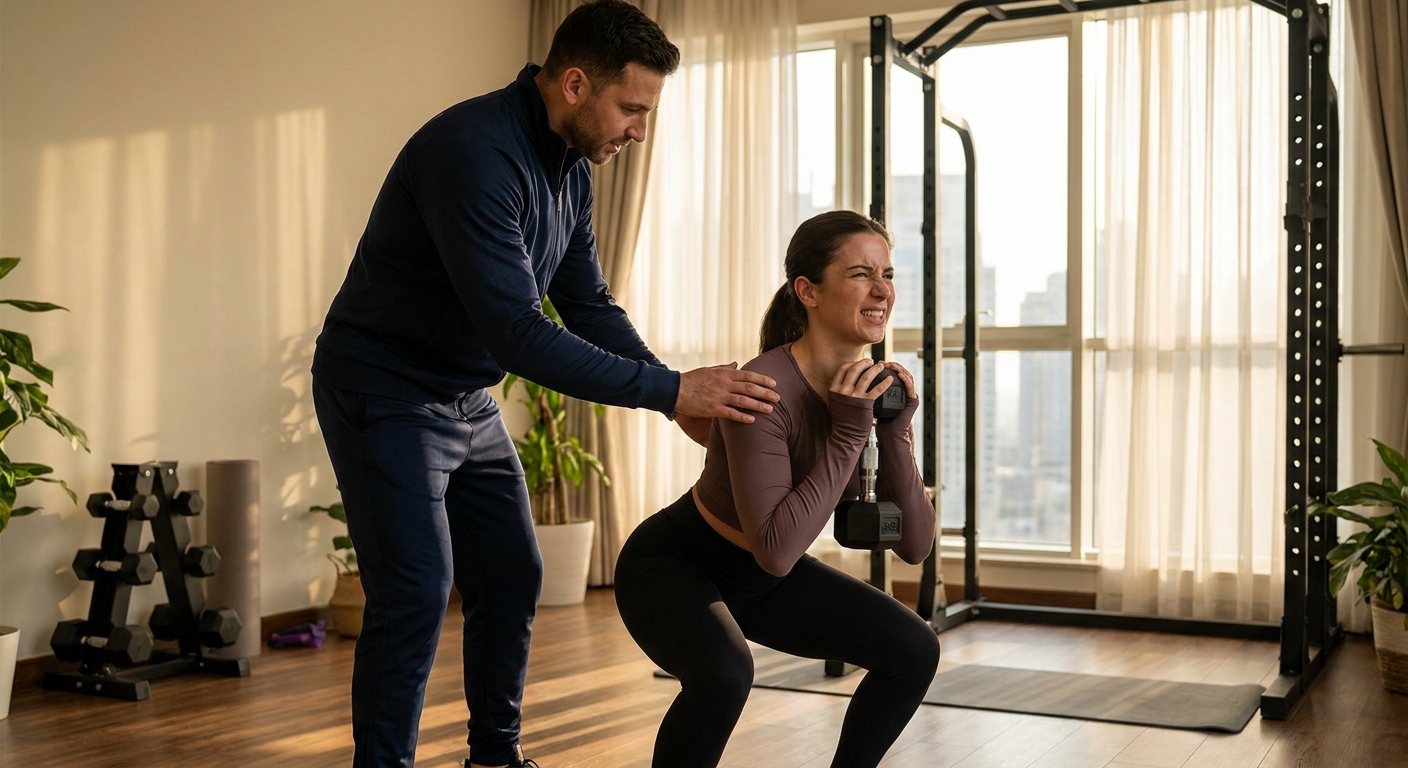
A 7 day week around a 9 to 6 office job
Here’s the week I’d give you if you’ve never lifted properly, built around a normal office day. Three strength days of 45 minutes, two interval days of 20 minutes, one long walk, one rest day. Under four hours, total, which fits around meetings and a commute.
- Monday: full body lift, 45 minutes, plank and dead bug to finish.
- Tuesday: 20 minutes of intervals in the building gym, then your steps.
- Wednesday: second lift, side plank and bird dog to finish.
- Thursday: no session. Steps and an early night.
- Friday: third lift, Pallof press and bicycle crunch to finish.
- Saturday: intervals again, or a 45 minute walk before brunch.
- Sunday: rest. Plan your food and put the sessions in your calendar.
- 013 × 1090s rest
Goblet squat
Chest tall, heels flat. Stop one rep before your form goes.
- 023 × 1090s rest
Dumbbell Romanian deadlift
Hips back, dumbbells slide down the thighs, flat back the whole way.
- 033 × 10 a side60s rest
One arm dumbbell row
Pull the elbow to the hip, not the shoulder to the ear.
- 043 × 8 to 1260s rest
Push up
Body in one line, elbows at 45 degrees. Hands on the counter if the floor is too hard.
- 053 × 30s hold45s rest
Front plank
Forearms down, squeeze the glutes, tuck the ribs. Hips sag, drop to the knees.
- 063 × 8 a side45s rest
Dead bug
Lower back pressed into the mat. Opposite arm and leg reach out slow, then return.
Week 1
Learn the moves. Keep two reps in reserve. Planks from the knees if your hips sag.
Week 2
Add 10 seconds to each hold. Add a fourth set to the squat and the row.
Week 3
Heavier dumbbells on squat, hinge and row. Full plank from the toes, 45 seconds.
Week 4
60 second planks. Side plank 30 seconds a side. Bicycle crunch 3 sets of 12. Then repeat, heavier.
The other core moves follow the same rule: 3 sets, holds from 30 seconds, reps from 8 to 10 a side. Side plank: elbow under the shoulder, hips lifted and stacked, hold. Bird dog: on all fours, opposite arm and leg out, pause, return. Bicycle crunch: hands behind your head, knee to the opposite elbow, slow, no pulling on your neck. Mountain climbers and Russian twists go on interval days, 30 seconds on, 30 off. All you need is a mat, a towel and one dumbbell, nothing else.
Dubai reality: heat, brunch and Ramadan
From May to October, outdoor cardio between 7am and 8pm is a bad idea, and not just an uncomfortable one. It’s 40 degrees plus with humidity stacked on top, so your plan moves indoors: the tower gym, a 2 by 2 metre patch of living room for the circuit, laps of the mall on a 15 minute lunch walk. Save the Marina walk and the corniche for November to March, and go early before the sun’s properly up.
The belly is the last place the fat leaves and the first place people give up.Lazar, Train With Us
The other Dubai problem is your weekend. A Saturday brunch with drinks runs 2,000 to 3,000 calories, sometimes more once the desserts show up, and undoes a week of small deficits in one sitting. Delivery apps do the same thing slower, one 11pm order at a time. Order from the same three places, pick the grilled option, skip the sides.
Instead of
- Shawarma platter, fries and a soft drink
- Late night pizza from the app
- Bottomless brunch package
Try
- Grilled chicken, salad and hummus
- Eggs and toast at home, then bed
- Brunch with two drinks and a walk after
Sleep and alcohol matter more than you’d think. Under 6 hours of sleep raises your hunger hormones, and you can end up eating noticeably more the next day without noticing why you’re reaching for the biscuits. Two large glasses of wine add a few hundred calories, and your body temporarily slows fat burning while it clears the alcohol out of your system. Stress does the rest, because cortisol pushes fat toward your middle no matter how clean you eat. Seven hours is the target, not five with a nap.
In Ramadan, lift about an hour after iftar once you’ve eaten something, or keep a short 25 minute session just before it. Keep protein near 40 g in each of your two meals, suhoor and iftar both, and walk after taraweeh rather than skipping it because you’re tired. If you fast by choice on other days, same rule applies: lift inside your eating window, not against it.
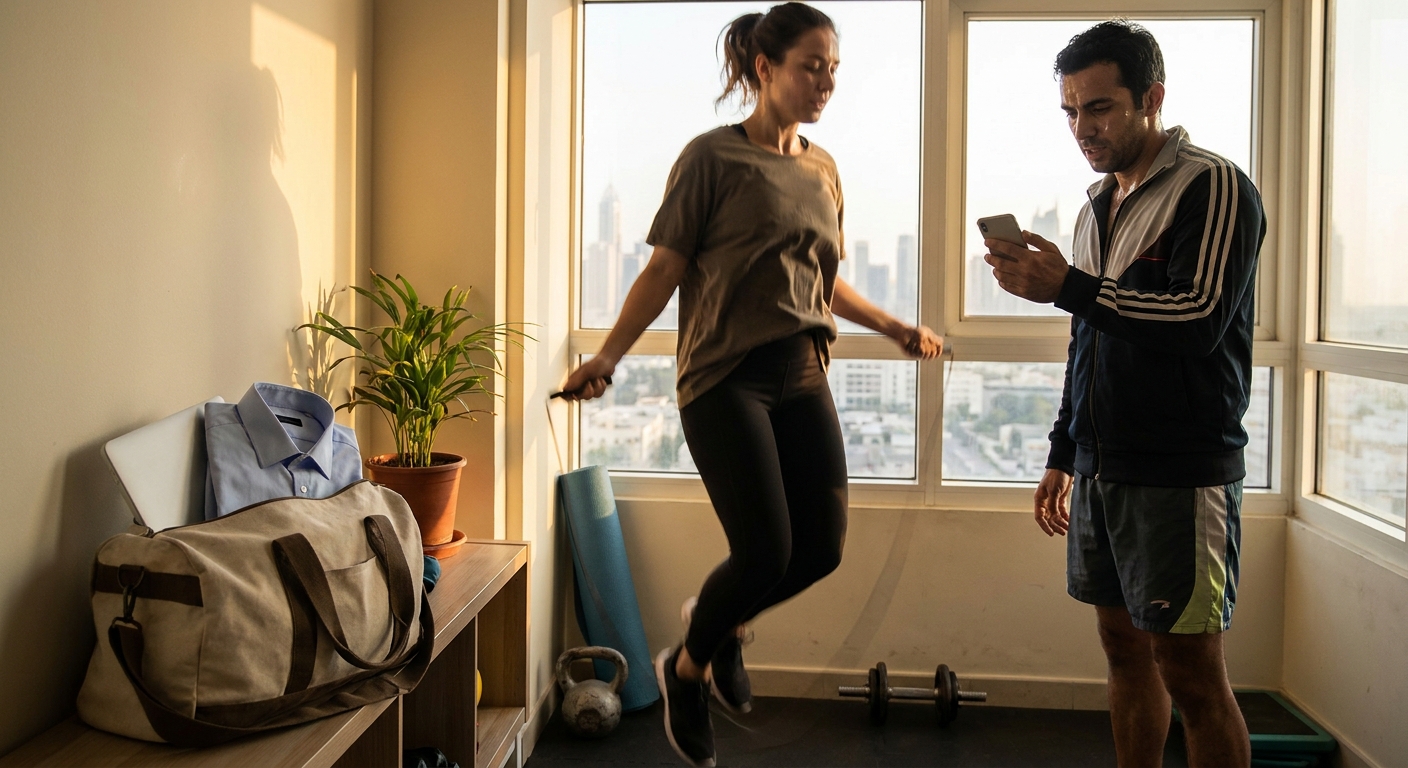
How to measure and what 12 weeks really looks like
Measure once a week, same morning, before breakfast, tape flat at your navel. Write it down. Ignore the daily scale. It swings a kilo on water and salt alone. Your two health lines sit at 94 cm for men and 80 cm for women.
A realistic loss is 1 to 2 cm a month off your waist, not the 5 cm the supplement ads promise.
- Weeks 1 to 4: most people see the scale move 2 to 3 kg, much of it water, and your clothes feel looser before the tape moves at all.
- Weeks 5 to 8: the tape usually starts to show 2 to 4 cm, and your face and shoulders lean out first, which is usually when people start asking what you’re doing differently.
- Weeks 9 to 12: your middle finally follows.
Most people quit at week 6, a fortnight before it starts to show, which is exactly why our own 12 week transformation program is built to outlast that drop-off point.
Before you blame fat, run this 30 second check. The lower belly pooch is often the wrong diagnosis.
| What you see | Likely cause | The check |
|---|---|---|
| Flat at 7am, round by 9pm | Bloating | Compare a morning and evening photo. A few cm in one day is food and gut, not fat. |
| Same size all day, soft, pinch is 3 cm plus | Fat under the skin | Pinch beside your navel. Fat moves with the skin as a thick fold. |
| Thin fold that hangs low | Loose skin | The fold wrinkles when you pull it. Common after a big loss or pregnancy. |
| Hard and round, pinch is thin | Visceral fat | High tape number, thin pinch. Take this one to your doctor. |
Crunches every day and nothing moving: the checklist
If you’ve trained for 6 weeks and the tape hasn’t moved, one of these is the reason. Go through it honestly. The training is rarely the problem.
- No real deficit. Track everything for 7 days, including oils, sauces and the milk in your coffee.
- The weekend erases the week. Two brunches and a delivery night can add 5,000 calories.
- Alcohol on more than 2 nights a week.
- Under 6 hours of sleep, or a 2am screen habit.
- Protein under 100 g a day, so you’re starving by 4pm.
- Steps under 5,000 because you drive to the gym and sit the rest of the day.
- The same weights for 6 weeks. If the dumbbells haven’t gone up, nothing else goes down.
And stop doing these. People arrive with them every month, sometimes all four at once. A daily workout for tummy fat built from 100 crunches just builds endurance in a muscle you can’t see yet, however sore it makes you the next day. Hour long slow treadmill walks as your only training burn maybe 300 calories and leave you hungrier by the time you’re home. Waist trainers and sweat belts squeeze water out, and it’s back by dinner. Detox teas are laxatives with marketing, nothing more.
If you already do belly fat exercises every day and nothing shows, you don’t need a harder ab routine. You need the deficit, the lifting and the steps.
Who should do this alone and who needs a coach
Most people can run the plan above alone. It costs you nothing but a tape measure and three to four hours a week, spread across a normal schedule. That’s the honest answer, and I’d rather you spent AED 0 and did it than paid us and didn’t.
A coach changes the outcome in three situations. You’ve tried the deficit twice and it hasn’t stuck, even when you knew exactly what to do. You’ve got a back, knee or shoulder history and don’t trust your own form under load. Or you’ve more than 10 kg to lose and want it done in a way that keeps your muscle instead of just dropping the number on the scale. Outside those three, skip us and use the plan above.
Works well
- Going alone if you already lift and only need the food side fixed
- Going alone if you like tracking and will measure every week
- Coaching if your week changes daily and someone else needs to hold the schedule
Worth knowing
- Coaching packages are AED 4,500 for 12 sessions or AED 12,000 for the 12-week transformation. We sell packages only
- We train in your tower gym or villa, so 45 minutes means 45 minutes, no commute
- Plan on 12 weeks with us, not four. Four weeks of crunches changes nothing
Special cases go to the right coach. If you’re postpartum, or if anything looks like diastasis recti, start with a doctor’s clearance and Maria’s pre and postnatal page, not crunches, and don’t cut calories while you’re nursing. Over 40, in menopause or living with PCOS, your programme shifts toward more lifting, more protein and fewer punishing intervals. Dunja’s page explains why.
If fat loss is the main goal, start with a weight loss personal trainer in Dubai. Women who want a female coach start on the female personal trainer page. If you’d rather have your lifting days coached inside your own building, that’s at home personal training in Dubai.
The bottom line: Eat 500 calories under, lift three times a week, walk 8,000 steps and measure once a week. Belly fat exercises are optional extras, not the plan. Give it 12 weeks before you judge it. If two honest tries haven’t moved the tape, get a coach. If they have, keep going alone.
If one of those three situations is you, message us on WhatsApp and we’ll tell you straight whether we’re the right fit. We’re selective. Eight years in Dubai and a 5.0 Google rating came from saying no to the wrong match.