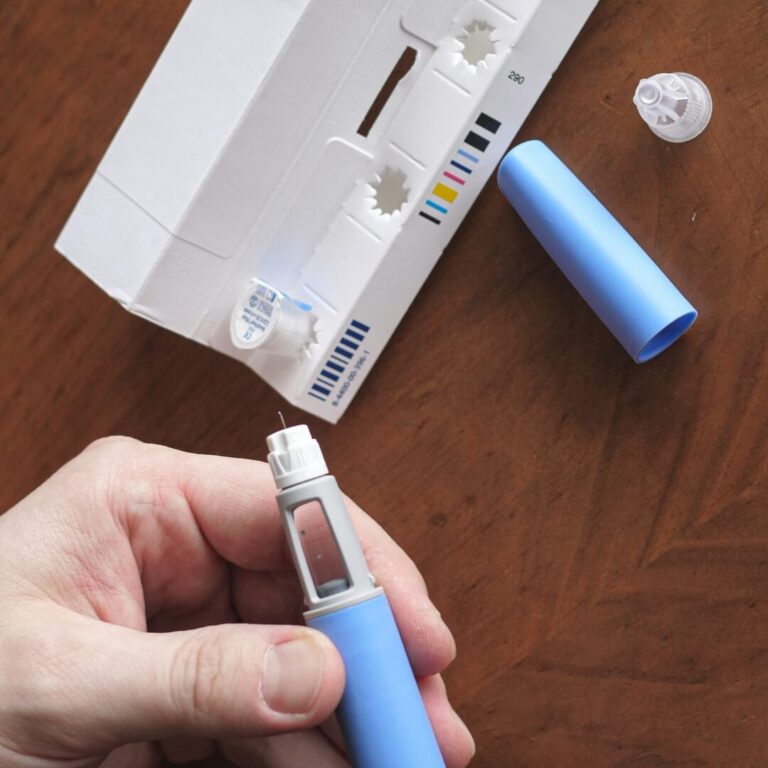

Belly fat exercises like crunches strengthen the muscle under the fat but don’t remove it. Your body loses fat from everywhere when you eat slightly less than you burn. The honest route is a daily step target, two or three strength sessions, some intervals, more protein and more sleep, for months not weeks.
Why belly fat exercises don’t burn belly fat
Your trousers fit in January. It’s September, the top button is a negotiation, and you’ve done crunches every morning for a month. The tape hasn’t moved a centimetre. That isn’t a willpower problem. Belly fat exercises build the muscle under the fat and leave the fat exactly where it was.
Search “exercises for stomach fat” and you’ll get twenty crunch variations. Fat doesn’t work that way. It comes off the whole body at once, in an order your genes decide, when you eat a little less than you burn for weeks on end. Research on ab-only training has consistently found that waist size, belly fat and body fat percentage barely move, even after weeks of daily ab work. People doing the crunches still got stronger through the midsection. They just didn’t get leaner there.
The stakes are bigger than a shirt button. Belly fat sits in two layers. Subcutaneous is the layer you can pinch between two fingers. Visceral wraps around the liver and gut, and that’s the one tied to type 2 diabetes and heart disease. You can be a normal weight on the scale and still carry a risky amount inside. A waist over 94 cm for men or 80 cm for women is the usual warning line, and a slim frame doesn’t rule it out.
This might be you if you’re a normal weight with a soft middle, too little muscle, and too many late dinners after a meeting that ran long. It’s the exact profile a personal trainer in Dubai sees every week. Same plan applies to you too, just more lifting and a smaller deficit. Either way, plan for 1 to 3 cm off the waist a month. Months, not weeks.
The exercise that burns the most belly fat
Nothing burns belly fat on its own, so the honest answer is whatever burns the most total calories and you’ll actually keep doing. For most people that’s walking. Ten thousand steps a day costs you no recovery time, and everything else stacks on top of it. Run six days a week without a base and you’ll be hurt or exhausted by week three, and then you’re back to zero.
Aim for 150 to 300 minutes of moderate cardio a week, or 75 to 150 if you go vigorous. That’s the WHO baseline, not something we invented. Moderate means you can hold a conversation but couldn’t sing along to one. You could do four brisk 30 minute walks. Or six 25 minute ones squeezed between your calls.
Intervals are the time saver among belly fat exercises that actually fit a busy week. Warm up for 5 minutes, then go 30 seconds hard and 60 seconds easy, 8 rounds, twice a week, on a bike, a rower or a flight of stairs.
- Do them if your joints are fine and you’re actually sleeping enough to recover.
- Skip them if you’re new to training or running on five hours a night. Walk instead.
Research comparing low and high intensity cardio has found they cut belly fat about equally, so the harder option isn’t automatically the better one. If your week has no room for even that, EMS training in Dubai compresses a similar strength stimulus into 20 minutes, though it still needs the walking underneath it. Skip EMS if you have a pacemaker or ICD, are pregnant, have epilepsy, or are recovering from recent surgery. Check with a doctor first.
Strength is the piece you’re missing if cardio is all you do. Muscle costs calories just to maintain, so more of it raises what you burn sitting in a meeting, and it decides whether you end up lean or just smaller.
- Two or three full body sessions a week.
- 3 sets of 8 to 12 reps.
- A load heavy enough that your last two reps are honestly hard.
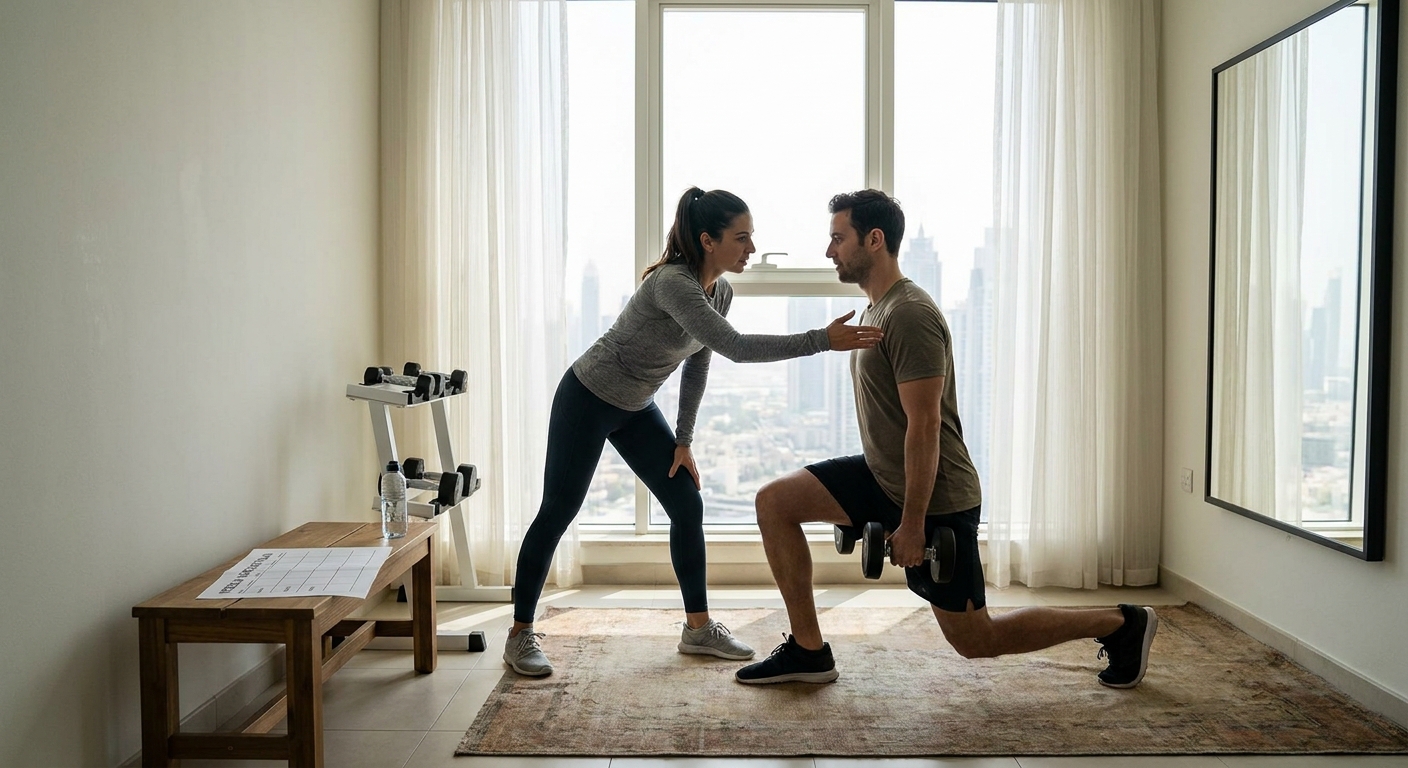
Research pooling data from overweight adults has found that diet plus training strips more fat from under the skin than diet alone. If good form is the part you’re unsure of, structured strength training with a coach gets you there faster than guessing alone in a corner of the gym.

Your seven day plan, three ways
Here’s your week, in minutes, built for someone with an actual job. This is what belly fat exercises look like once they sit inside a real week, not a stand-alone fix. The three columns are the same plan with different tools, so don’t overthink which one to pick. Choose one column and stay in it for four weeks before you judge anything. If you’d rather someone else build and adjust the plan for you, this is the same structure behind our 12 week transformation program.
| Day | No equipment at home | Dumbbells and bands | Gym |
|---|---|---|---|
| Mon | Strength A, 40 min circuit | Strength A, 45 min | Strength A, 50 min |
| Tue | Walk 45 min | Walk 45 min | Incline treadmill 40 min |
| Wed | Intervals 20 min, stairs | Intervals 20 min, swings | Intervals 20 min, rower |
| Thu | Walk 45 min, core 10 min | Walk 45 min, core 10 min | Walk 45 min, core 10 min |
| Fri | Strength B, 40 min circuit | Strength B, 45 min | Strength B, 50 min |
| Sat | Long walk 60 min | Long walk 60 min | Swim or bike 45 min |
| Sun | Rest, 8,000 steps | Rest, 8,000 steps | Rest, 8,000 steps |
That’s about five hours a week, spread out so no single day wrecks your evening. On a day with only 20 minutes, run the strength session with no rest between moves and stop there. Twenty minutes finished beats sixty minutes planned and never started.
- 013 × 1090s rest
Goblet squat
Keep your chest tall, heels flat, and sit down between your heels. Stop one rep before your form breaks down.
- 023 × 1090s rest
Dumbbell Romanian deadlift
Push your hips back and let the bells slide down your thighs. Keep a flat back and soft knees the whole way.
- 033 × 8 to 1260s rest
Push-up
Hands under your shoulders, body in one straight line. Lower your chest to a fist’s height off the floor.
- 043 × 10 each side60s rest
One arm row
Drive your elbow to your hip pocket, not the ceiling. Pause a second at the top of every rep.
- 054 × 1545s rest
Kettlebell swing
This is a hip snap, not a squat. Keep your arms like ropes. Start at 12 kg for most women, 16 kg for most men.
Interval days use the ab moves everyone searches for anyway. These are the cues we give in sessions, and the mistake we correct most.
- Mountain climbers. Keep your hips level with your shoulders and drive the knees to your chest. Most people let the bum ride up in the air.
- Burpees. Step back if you need to, and only jump if you can land quietly. The back sags on the way down when people rush it.
- Squat jumps. Land soft, heels down, and sink straight into the next rep. Landing on the toes with locked knees is what wrecks knees.
- Jumping lunges. Keep the front shin vertical and switch legs in the air. A back knee crashing into the floor is the usual mistake.
- High knees. Chest tall, knees to hip height, quick feet under you. Leaning back is the tell that you’re getting tired.
- Plank. Glutes tight, ribs tucked. Thirty seconds done properly beats three minutes held badly.
Belly fat exercises like these stay in the plan for posture and a stronger lift, not for the fat sitting on top of it. Dead bugs, side planks and Pallof presses beat sit-ups, done for ten minutes after a walk. A routine built only from sit-ups is a posture session wearing a fat loss label.
Heat, steps and Ramadan, the Dubai version
From May to October the pavement hits 45 degrees and the humidity makes it feel worse. You can train outdoors safely before 7am and after 8pm, and that’s the whole window. The Kite Beach track at 6am is fine. The same track at noon is a heatstroke risk, not a workout.
- The tower gym treadmill at a 10 percent incline.
- A lap of a big mall before you shop.
- A circuit in the living room with the AC on.
That list is where everything else moves when the pavement is off limits. From November to April, flip it and take the walks and intervals outside whenever suits you.
Steps are the lever nobody names. If you drive from your basement parking to the office car park, 3,000 to 4,000 steps a day is normal, and that gap alone can cancel out a whole training session. Aim for 8,000 a day, 10,000 on rest days. Three ways to get there without melting:
- Park at the far end and take the stairs, every single time.
- Walk every phone call along the corridor or a lap of the floor.
- Put a 20 minute treadmill walk after lunch, right before the afternoon slump hits.
Ramadan gets its own version, built around when you can actually train.
Keep protein in both suhoor and iftar. The tape will probably hold rather than drop, and that’s fine. Protect the muscle, then pick the deficit back up after Eid. You’ll probably gain a little water weight over the month and lose it again in the first week back on the plan, so don’t panic at the scale on the first of Shawwal.
Food, protein, sleep and stress
You can’t out-crunch a delivery app.Lazar, Train With Us
Your diet does most of the work here. A deficit of 400 to 500 calories a day, roughly half a kilo a week, is enough and rarely wrecks your training. Push it harder and you’ll lose muscle, sleep and patience, in that order.
Protein is the one number worth remembering: 1.6 to 2.2 g per kilo of your bodyweight, so an 85 kg man is aiming at about 150 g a day. One plate gets you a third of the way there: 200 g of grilled chicken or hammour, a fist of rice, half the plate in vegetables, olive oil on top. That’s close to 60 g of protein in one sitting.
The local traps are specific, so the swaps should be too. Friday brunch gets one rule and no exceptions.
Instead of
- Friday brunch with unlimited drinks and four plates
- A 10pm delivery order after the client dinner runs late
- The iced caramel latte from the chain downstairs
- Dinner at 9:30pm because that’s when you got home
Try
- One plate, protein first, a glass of water between every drink
- Order at 7pm from the office, grilled protein and salad, eaten by 8
- A flat white or an Americano with no syrup, about 300 calories lighter
- A 300 calorie protein plate at 9:30, with the proper meal moved to lunch
Sleep under six hours pushes hunger the wrong way, and you’ll eat it back the next afternoon without noticing you’re doing it. Seven hours matters more than the intervals do. Stress works through the same route: cortisol, then late eating. A 10 minute walk after the last call, not a fourth coffee, is the easiest fix you’ll find.
How to measure, what the first 14 days feel like, and fixing a plateau
The scale lies for the first two weeks, so the tape is your real number. Keep the protocol boring and repeatable, because boring is what makes it trustworthy.
- Tape at navel level, relaxed, before breakfast, after the bathroom.
- Same morning every week. Friday suits most people here.
- Photos every four weeks, same light, same spot, same shorts.
- Weigh daily if it doesn’t bother you, but only read the seven day average.
A realistic range at that deficit is 1 to 3 cm off your waist a month. Your body picks the order, usually the face and arms first, the belly last for men, hips and thighs last for women. That’s genetics, not a lack of effort.
Week one the scale usually drops 1 to 2 kg. That’s water and stored carbohydrate, not fat. Week two it bounces back up a kilo, because new training makes sore muscles hold water. This is the exact point where most people quit. The message we send at day 10 is short: the scale is measuring water, the tape is measuring you, so keep going.
When the tape stops moving for two straight weeks after week six, change one thing, in this order. Add 1,500 daily steps first. If nothing moves in a fortnight, swap one walk for an interval session. Then, and only then, cut 150 calories, mostly from the late meal. Never all three at once, or you’ll never know which one actually worked.
Doing it alone, a gym, or a coach
Walking and a living room circuit cost nothing. A gym membership in Dubai runs from roughly AED 150 a month at the big chains to over AED 1,000 at the premium clubs, and you’re paying for the room, not the plan. A coach who trains you in your own building starts from AED 4,500 for a package, and that price buys the plan, the tracking, and someone who actually shows up at the hour you picked.
Works well
- Alone, if you already lift and the tape is moving. Keep going.
- A gym, if the tower gym is empty at 7pm and you like machines.
- A coach, if you’ve started three times this year and stopped three times.
Worth knowing
- Alone fails on the plan, not the effort. Most people repeat the same session for a year.
- A gym adds a commute. SZR at 7pm eats the session before it starts.
- Coaching is the wrong buy if food is the only problem. Fix the food first.
This plan suits you if you’ve got a waist past 94 or 80 cm, a desk job, a car and five hours a week to give it.
It’s not for you yet if any of these apply. Get a doctor’s clearance first, and skip the intervals until you have it in hand.
- You’re pregnant. See a coach who works with pregnancy and postpartum instead.
- You’re fresh from surgery.
- You’re living with a heart condition.
If you’re already lean and chasing visible abs, that’s a different article about a much harder deficit.
Knowing the plan and actually running it every week are two different things. A coach can train you in your own building, programme the sessions, track the tape, and adjust things when they stall. It’s the right buy when the problem is consistency, not knowledge.
It’s a scheduling problem, not a knowledge gap.Lazar, Train With Us
Plenty of people in Marina and JLT know exactly what to do and still don’t do it on a Tuesday at 6am alone. A coach is the one thing that actually fixes that. If you can run this week on your own, do exactly that instead.
The bottom line: Belly fat leaves when the whole body’s fat leaves, and that’s mostly food, then movement. Walk 8,000 steps, lift twice, sleep seven hours, eat protein first, and measure the waist every Friday for three months before you judge anything. Crunches can wait.